
Most technology projects funded from London are designed for conditions that do not exist where they are deployed. The app assumes 4G. The dashboard assumes a laptop. The training assumes literacy. Six months after the grant closes, nobody is using it.
We spent 2026 building a safety app for small-scale fishermen on the Makran coast of Balochistan, Pakistan. The programme was run by the Youth Association for Development (YAD) Pakistan and supported by Lloyd’s Register Foundation, the UK global safety charity. JahaSoft Ltd, registered at Companies House in Wolverhampton, delivered the software.
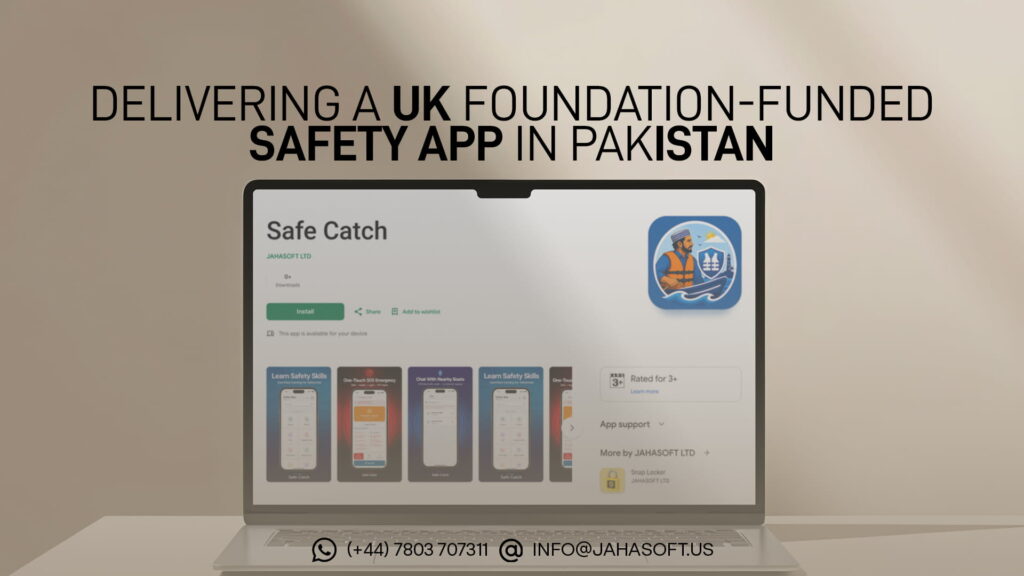
The app is called Safe Catch. It is live on Google Play. It works with no internet connection at all.
This is a write-up of how the delivery was structured, what the field conditions forced us to change, and what we would tell any UK foundation or charity funding a technology component overseas.
The gap between a grant proposal and a working app
UK funders are, in our experience, good at assessing whether a programme is needed. They are much less well served when it comes to assessing whether the technology inside that programme will survive contact with the field.
The usual failure pattern goes like this. A grant includes a line item for a mobile app. A development agency is appointed, often on price. The agency builds something that demos beautifully in a meeting room, deploys it, and moves on. Nobody discovers the app cannot open without a data connection until the field team is standing on a beach with fifty fishermen and no signal.
The money is spent. The programme reports an output. The safety outcome does not materialise.
Avoiding that requires the technical constraints to be treated as the primary design input rather than a detail to be worked out later. On Safe Catch, they were.
The project in brief
Beneficiaries: 50 small-scale fishermen operating out of Gwadar District, Balochistan, principally around Padi Zar and Demi Zar.
Problem: Sudden Arabian Sea weather, no reliable mobile coverage more than a few kilometres offshore, no structured safety training, low literacy rates, and no practical way for a fisherman in distress to reach the Maritime Security Agency or the Fisheries Department.
Delivered: A free Android application under 25 MB, running on Android 7.0 and above, providing emergency SOS with GPS transmission over 2G SMS, Bluetooth boat-to-boat relay, offline seven-day weather forecasting, full-screen severe weather alerts, and a five-module safety training course narrated in English, Urdu and Balochi.
Status: Published on the Google Play Store and deployed to the pilot cohort.
View Safe Catch on Google Play
What the field conditions forced us to build
Four constraints shaped every technical decision. None of them appear in a standard app development brief.
The app cannot depend on the internet
Not “should degrade gracefully offline” — cannot depend on it. Mobile coverage disappears within a few kilometres of the Makran shoreline, and connectivity on land is periodically disrupted.
Everything in Safe Catch runs from local storage. Training, audio, the emergency system and the last downloaded forecast all function in airplane mode. When the phone does touch a connection, even briefly at the harbour, the app refreshes the full seven-day forecast in the background without the user doing anything.
The emergency alert has to work with no signal at all
The SOS is a three-second hold, which prevents accidental triggering. When it fires, four things happen simultaneously: an SMS carrying the fisherman’s name, boat name and GPS coordinates goes out over 2G; a repeating audio alarm sounds; the camera flash blinks the Morse SOS pattern for night visibility; and the app scans over Bluetooth for other boats running Safe Catch, handing the alert to any it finds so the message can relay from vessel to vessel until one has coverage.
There are also six weather-specific SOS buttons — sunny, cloudy, raining, windy, thunderstorm, severe storm — each sending a pre-written message describing both the distress and the conditions. A rescue coordinator responds differently to a boat in trouble during a thunderstorm than one in flat calm.
It has to run on the phones people actually own
We capped the APK at 25 MB and targeted Android 7.0. That is not a technical flourish; it is the difference between an app that installs on the handsets circulating in Gwadar’s fishing community and one that does not.
It has to work for users who cannot read
Every screen carries a speaker button. Tap it and the content is read aloud in the user’s chosen language. The training modules are built as one picture, one short sentence and one audio clip per screen. A fisherman who has never read a page of Urdu can complete the entire safety course.
The Balochi narration uses the Makrani dialect spoken on that stretch of coast, not a generic recording. Audio was recorded and re-recorded until the field team confirmed it sounded local.
How the delivery was structured
JahaSoft operates as three registered entities: JahaSoft Ltd in the United Kingdom (Companies House 14653641), JahaSoft (SMC-Private) Limited in Pakistan, and JahaSoft LLC in the United States.
For Safe Catch, that structure did real work rather than sitting decoratively in a footer.
A UK contracting entity. Contracts, invoicing and correspondence sit with a Companies House registered company, subject to UK company law, with a UK bank account and UK VAT treatment where applicable. For a UK funder or charity trustee board conducting due diligence, this removes a category of friction entirely.
A Pakistani delivery team. The engineering, design and audio production happened in Quetta, roughly 700 kilometres from Gwadar but inside the same province, with staff who speak the languages and understand the coastal context. Field testing happened in Gwadar itself with YAD’s Safety Champions.
A local implementing partner holding the relationship. YAD ran the community engagement, participant selection and training rollout. We built software. Those are different competencies and keeping them separate produced a better result than either party attempting both.
The practical benefit for the funder is that oversight and accountability sit in a familiar jurisdiction while delivery costs and cultural proximity sit where the work happens.
Governance points that mattered
Three areas cause more trouble in grant-funded technology than any technical challenge. All three should be settled in writing before development starts.
Intellectual property. All source code, design files, audio assets, branding and Play Store listing ownership transferred to YAD Pakistan on delivery. JahaSoft retains nothing. This should be the default expectation in any grant-funded build, and it frequently is not — a great many NGOs discover years later that their agency still controls the code and the app store account.
Data protection. Safe Catch collects no personal data and shares nothing with third parties. Training progress is stored locally on the device. Location is accessed only when the user triggers an SOS or opens the weather screen. For a project working with a vulnerable community in a politically sensitive region, collecting nothing was the correct design decision, not a limitation.
Ongoing costs. After handover, the recurring costs are small and fully disclosed: an Apple Developer Program fee if an iOS build is added, and hosting and domain renewal for any web component. Android publishing carries a one-off registration fee and no annual charge. Nothing is hidden and nothing depends on JahaSoft continuing to be engaged.
What we would tell a UK funder financing a field technology project
A few things we would put in front of any programme officer or trustee before signing off a technology line item.
Ask what happens with no connectivity, and ask for a demonstration. Not a description — a phone in airplane mode in the room.
Ask who owns the code on day one after handover. If the answer takes more than one sentence, that is your answer.
Fund audio, not just interface. For low-literacy users, the narration is the product. It is also the line most often cut when budgets tighten, which is exactly backwards.
Budget for field testing, not just user acceptance testing. A usability session in an office tells you nothing about screen legibility in direct Balochistan sunlight on a moving boat.
Ask for the app size. It is a single number and it tells you whether the developer has thought about the target device at all.
Read the full field story
The detailed account of how the app works on the water — the SOS chain, the Bluetooth mesh, the training modules and the pre-loaded emergency numbers — is published on our Pakistan site: Safe Catch: A Balochistan-Built Safety App for Gwadar’s Fishermen.
Working with JahaSoft Ltd
We build software for environments where the standard assumptions do not hold: no reliable connectivity, low literacy, low-cost devices, multiple languages, and communities that will simply stop using anything that is difficult.
If you are a UK charity, foundation, social enterprise or programme team planning an app, web platform or custom system — whether the deployment is in Britain or overseas — we would be glad to talk it through before you write the specification. Early conversations tend to save considerably more than they cost.
Telephone: (+44) 7803 707311 Email: INFO@JAHASOFT.US
You can see the full range of what we build on our services page, or send project details through the contact form.
Safe Catch was developed by JahaSoft Ltd, a software company registered at Companies House in the United Kingdom with delivery teams in Pakistan. It was built for the Youth Association for Development (YAD) Pakistan as part of a programme supported by Lloyd’s Register Foundation.
Yes, provided the delivery team has genuine local presence. On Safe Catch, contracting and accountability sat with the UK entity while engineering, language work and field testing were carried out in Balochistan by staff based in the region. A UK company with no in-country team would have struggled with the language and field-testing requirements.
That depends entirely on what the contract says, which is why it should be agreed before development begins. On Safe Catch, all source code, design assets and app store ownership transferred to YAD Pakistan on delivery. We recommend this as the default for any grant-funded build.
A normal app calls a server for most of what it displays and fails without a connection. An offline-first app stores everything locally and functions completely without one, synchronising in the background when connectivity happens to be available. It requires more engineering effort but is the only workable approach in low-connectivity regions.
Yes. We work with charities, foundations, social enterprises and commercial clients in the UK and internationally, on mobile apps, web platforms, custom software and AI automation. Contact us on (+44) 7803 707311 or at INFO@JAHASOFT.US.
Yes. The underlying architecture — local storage, background synchronisation, SMS alerting, multilingual audio and peer-to-peer relay — transfers to health, agriculture, disaster response and education programmes in any low-connectivity setting. Only the content and languages change.
Yes, it is free on the Google Play Store, with no subscription, in-app purchases or advertising.
JahaSoft Ltd is registered in England and Wales, company number 14653641, with a registered office in Wolverhampton. The company also operates registered entities in Pakistan and the United States.